Overview of training a LLM

Corpus (raw)

Preprocessed Training Data Tokenized Training Data Base LLM Fine-tuned LLM

Corpus (labelled)

Corpora for training data

Corpus (raw)

  • LLMs are trained on large diverse datasets such as books, Wikipedia, websites, code, scientific articles and social network platforms.
  • For example, LLaMA1 used:
    • (67%) CommonCrawl: web archives from 2017 to 2020
    • (15%) C4: pre-processed CommonCrawl
    • (4.5%) GitHub: repos distributed under Apache, BSD, and MIT licenses
    • (4.5%) Wikipedia: online encyclopaedia
    • (4.5%) Gutenberg and Books3: books from Project Gutenberg and the Pile dataset
    • (2.5%) ArXiv: scientific preprints
    • (2%) Stack Overflow: a high quality Q&A website

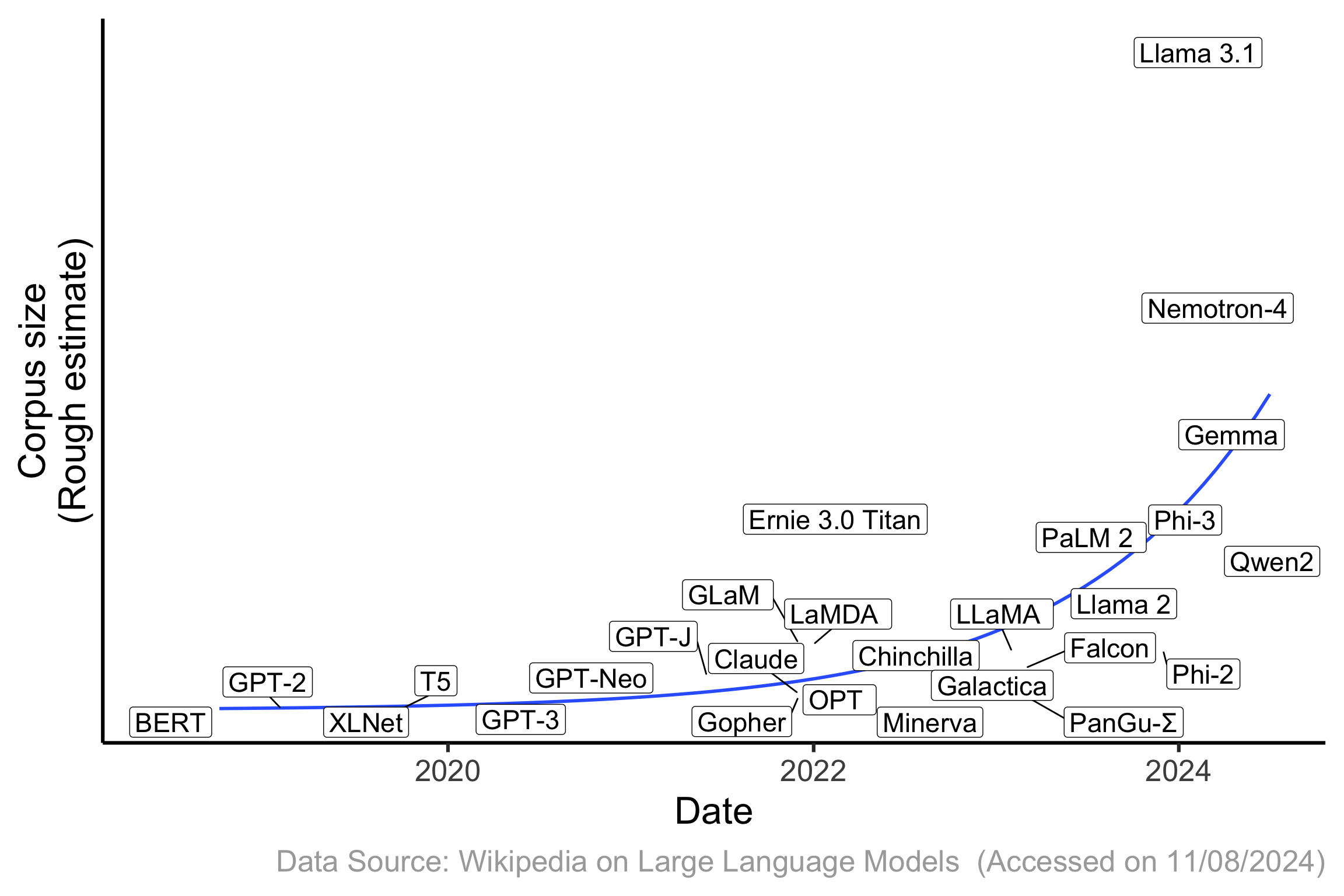
Corpus size used for training increasing over time

Figure 1
  • Note: not all vendors publicly document their corpus size for training.

Tokenization

Input Where there’s a will, there’s a


Token Where  there ’s  a  will ,  there ’s  a

Token ID 11977 1354 802 261 738 11 1354 802 261

LLM

2006

way

Embeddings

  • Language modelling typically use (token) embeddings.
  • Embedding models convert items to numerical vectors such that similar items are closer together than dissimilar items based on this embedding space.
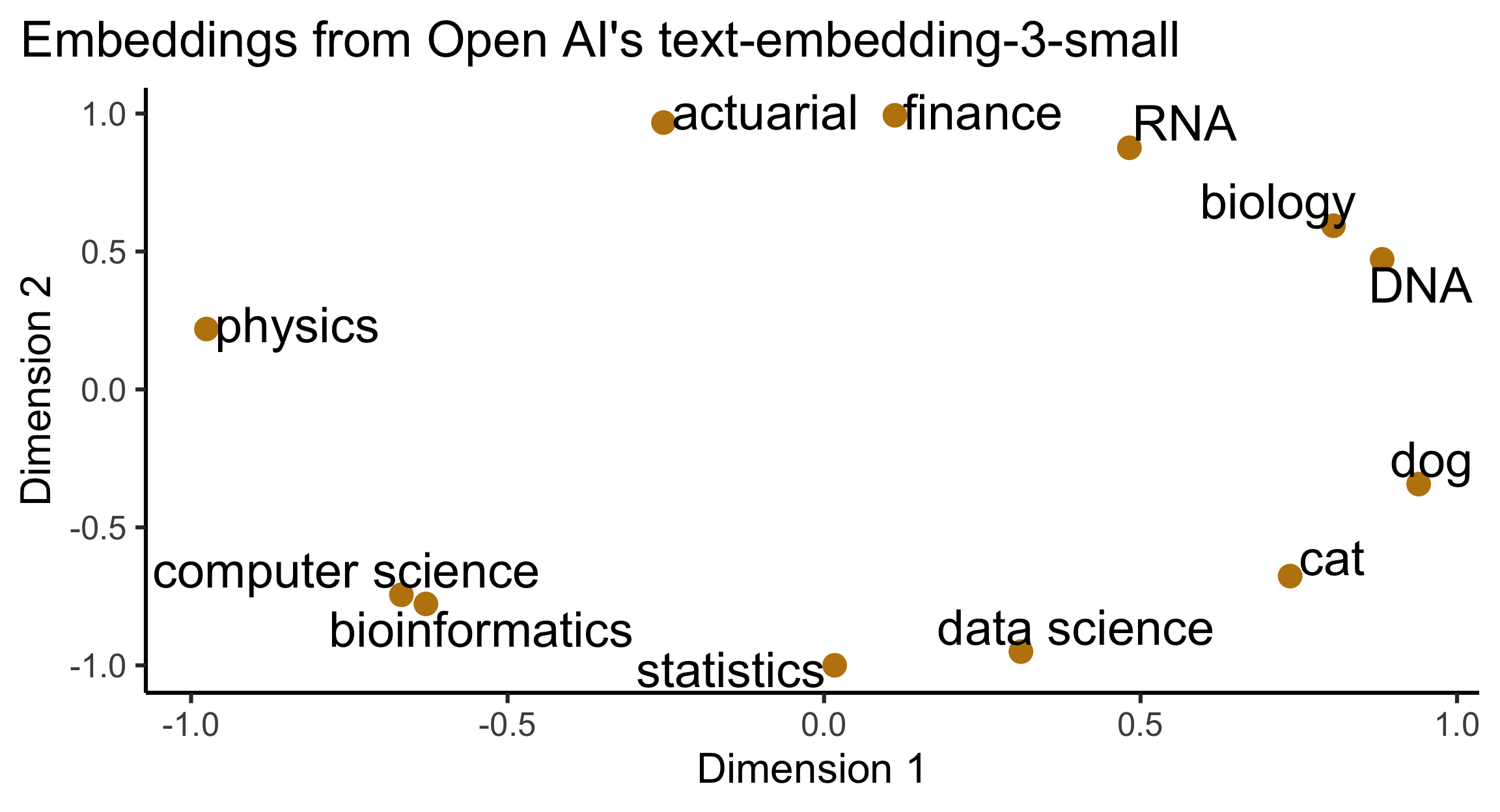
  • Text embedding models are often based on artificial neural networks.

Artificial neuron

  • The artificial neuron is an elementary unit of an artificial neural network.

  • The artificial neuron receives inputs \boldsymbol{x} = (x_{1}, \dots,x_{p})^\top that is typically combined as a weighted sum: z = b + \sum_{j=1}^pw_jx_{j} = b + \boldsymbol{w}^\top\boldsymbol{x}, where \boldsymbol{w} = (w_1, \dots, w_p)^\top are weights and b referred to as bias.

  • The z then get passed into the activation function, h(z), e.g. 

    • Linear: h(z) = z,
    • Sigmoid: h(z) = (1+e^{-z})^{-1} (a.k.a. a logistic function), and
    • ReLU: h(z) = \max(0, z).

Visualising an artifical neuron

Input layer

1


x_1


x_2

Output layer

h = ReLU

h(z)


  • When x_1 = 1 and x_2 = 3, then \begin{align*}z &= b + w_1x_1 + w_2 x_2\\ &= 1 + 0.5 \times 1 - 3\times 3 = -7.5.\end{align*}

  • Using ReLU, the prediction is \max(0, z) = 0.

Artifical neural network: regression

Input layer


1


x_1


x_2

Hidden layer
h_1 = ReLU

1


h_1(z_{11})


h_1(z_{12})


Output layer
h_2 = Linear


h_2(z_{21})


  • The number of nodes in the input layer is constrained by the (modified) input data.
  • The number of nodes in the output layer is constrained by the desired output (regression or classification).

Artifical neural network: classification

Input layer


1


x_1


x_2

Hidden layer
h_1 = ReLU

1


h_1(z_{11})


h_1(z_{12})


Output layer
h_2 = Softmax

h_2(\boldsymbol{z}, 1)


h_2(\boldsymbol{z}, 2)


h_2(\boldsymbol{z}, 3)


Assume classification to K classes.


Softmax:

h(\boldsymbol{z}, i) = \dfrac{\exp(z_i)}{\sum_{j=1}^K\exp(z_j)}

Output node i contains the “probability score” associated with class i.

Feed forward neural network

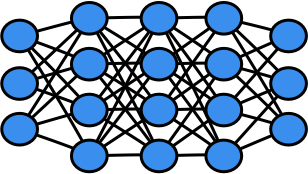
  • Feed forward neural networks, also called deep neural networks, add more hidden layers.
  • The output depends on the parameters, \boldsymbol{\theta} = (\underbrace{\boldsymbol{b}^\top}_{\text{biases}},\underbrace{\boldsymbol{w}^\top}_{\text{weights}})^\top.
  • The number of parameters increases exponentially with more layers, but you gain flexibility in modelling.
  • These parameters are calibrated (or trained) by:
    1. Defining an objective (or loss) function (like the mean square error), and
    2. Finding parameters \boldsymbol{\theta} that optimise this objective function (using techniques like stochastic gradient descent and backpropagation).


Embedding model: Word2Vec for illustration of an embedding process

  • Word2Vec1 is one of the early unsupervised word embedding models based on a three-layer neural network using a fixed window size.

Training data: Statisticians analyse data Training mode: Continuous Bag Of Words Vocabulary size: 5     Window size: 3     Aim: Predict middle word

Statisticians

1
0
0
0
0

data

0
0
1
0
0

Input


Output


0.01
0.89
0.04
0.01
0.01


Actual:

analyse

0
1
0
0
0

Transformer model

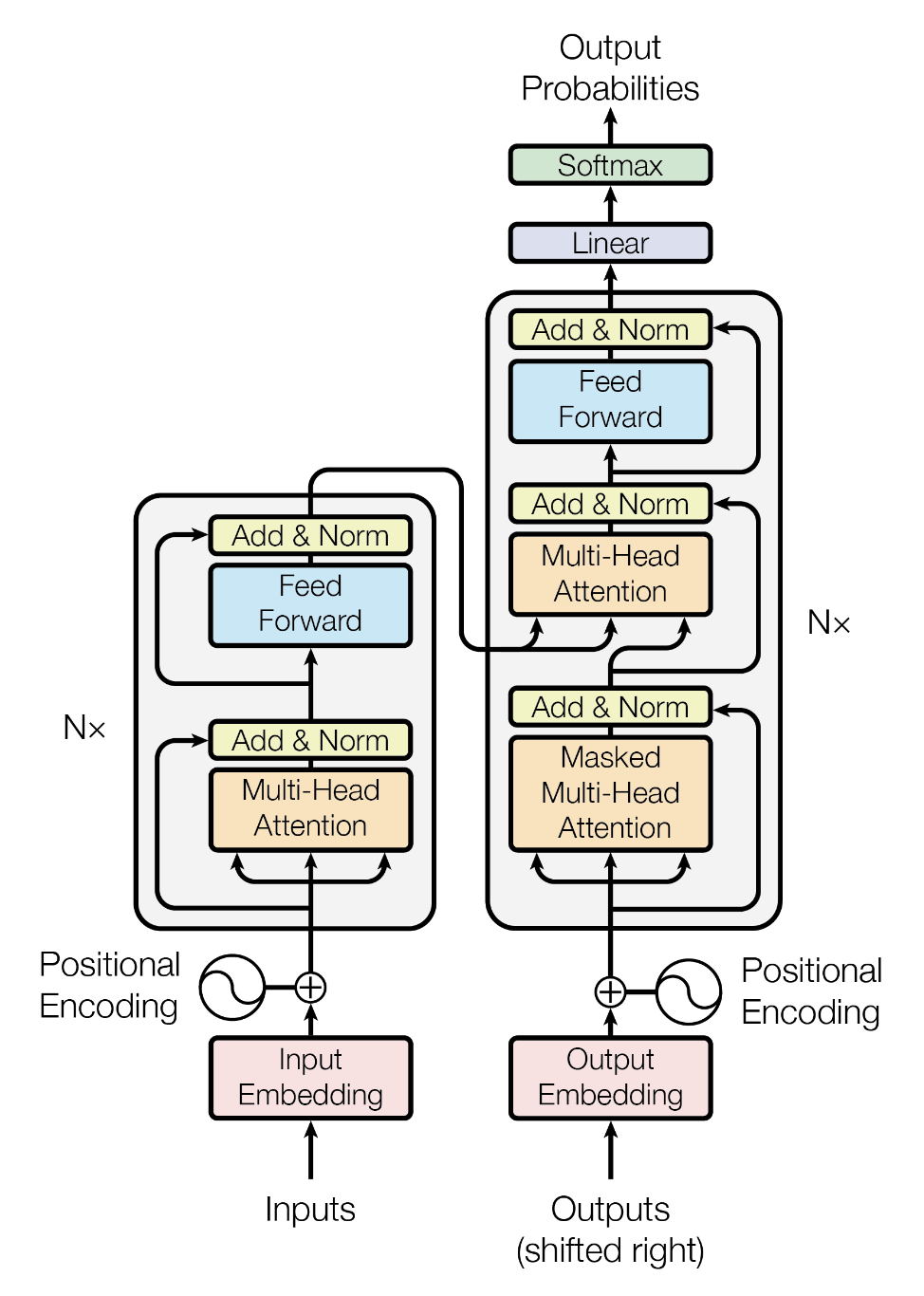
  • Popular LLM are variants of a pre-trained transformer model.
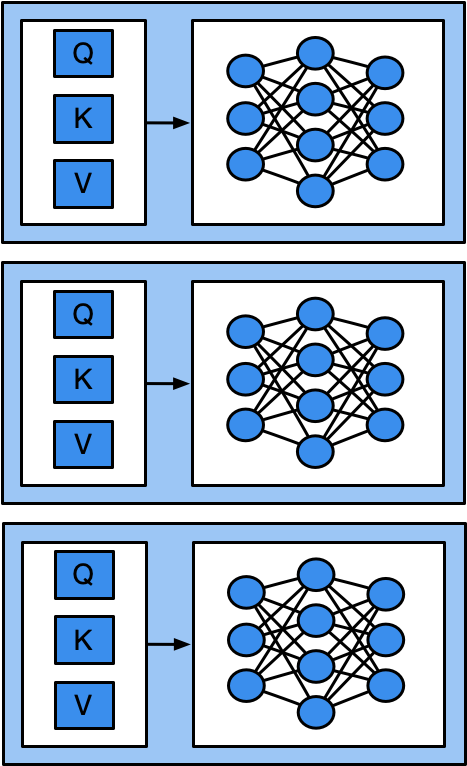
  • The original transformer model1 consist of:
    • Input embeddings of current and previous positions
    • Positional embeddings
    • A stack of transformer blocks (N=6) with each containing:
      • An attention layer with multiple attention heads
      • Normalisation layers
      • Feed forward neural network with 3 hidden layers:
        Linear, ReLU, then Linear
    • Un-embedding layer (Softmax)

Original transformer model by Vaswani et al (2017)

Positional embeddings

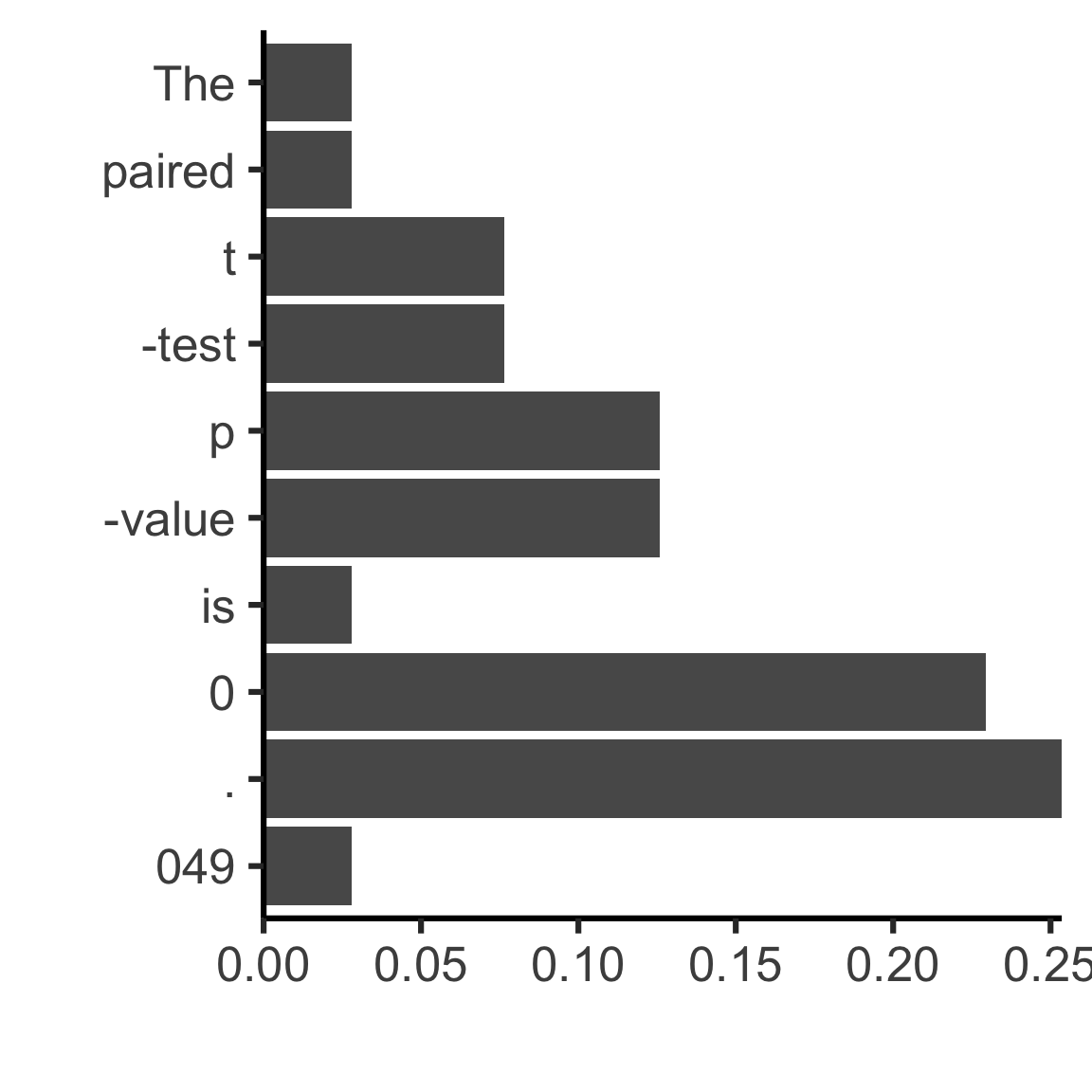
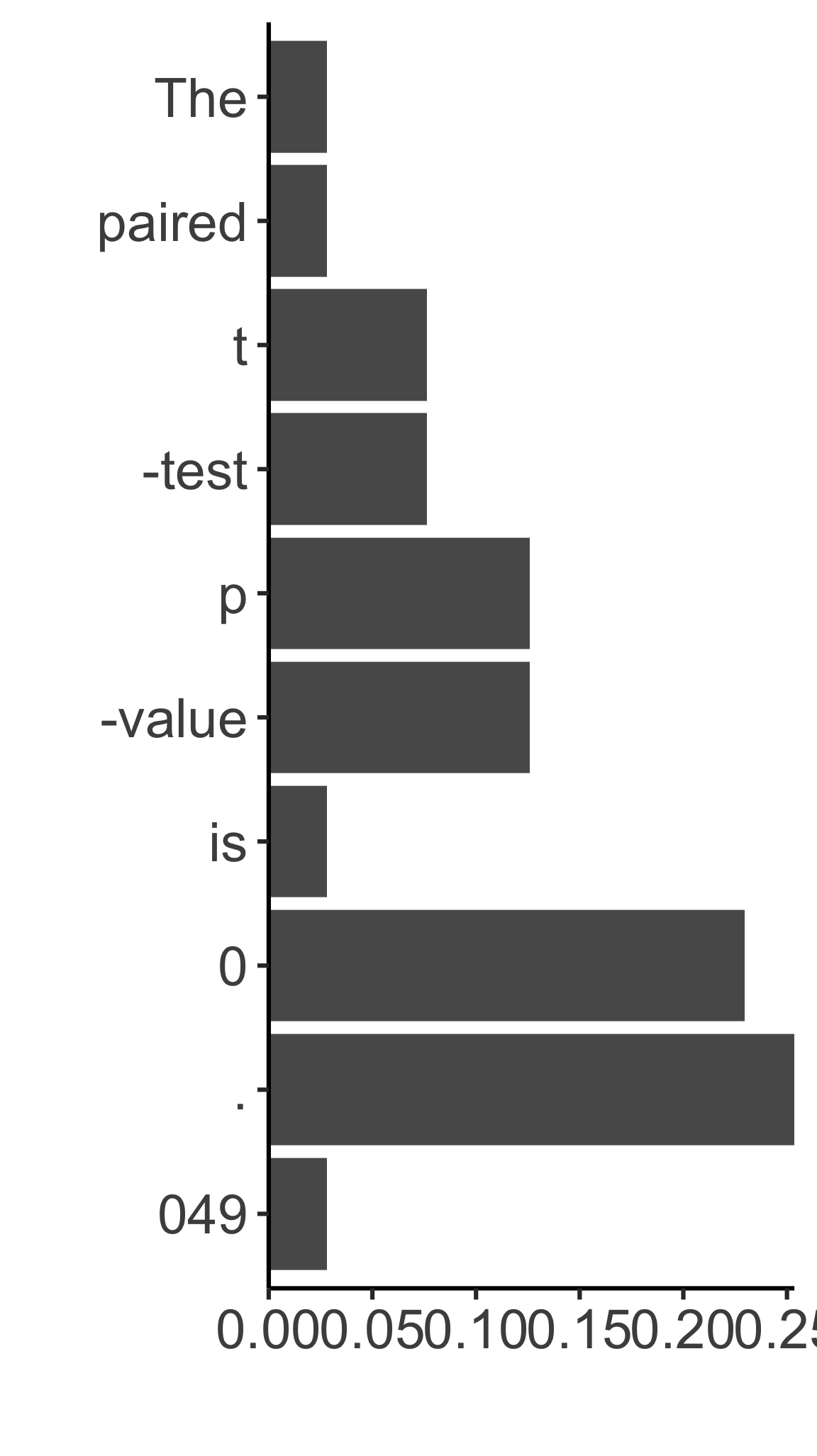
Input The paired t-test p-value is 0.049, so it is statistically significant

Token The paired  t  -test p  -value  is  0 . 049 , so it is statistically signicant

  • Context length: below 10 (typically much larger, e.g. 4096 for llama3.1:8b)

The paired  t  -test p  -value  is  0 . 049

  • Transformer blocks are blind to position of token, so incorporate information about relative or absolute positions of tokens for the subsequent steps.
  • Position embedding in the original transformer is represented by unique frequencies and offsets of the wave:

Figure 2

Attention head: Projection matrices

  • The goal of attention layer is to incorporate relevant information of previous tokens into the current token.

The paired  t  -test p  -value  is  0 . 049

  • Suppose the current position is 049 – the neural network doesn’t know what this token refers to without looking at the previous tokens.
  • The attention head consists of query, key, and value projection matrices.

Attention Head: Relevance scoring

  • Embedding matrix is multiplied with each of the projection matrices


\times

The query vector of the current position:


=


Result \rightarrow Softmax(Result)
Attention Head: Combining information


\times


=


Sum above and the new token embedding that incorporates relevant information from other tokens is:

Summary

Input:

All models are wrong, but some are

Updated input:

All models are wrong, but some are useful

Updated input:

All models are wrong, but some useful.


Tokenizer


Embedding layer


Transformer blocks
(artificial neural network)


Un-embedding layer


Token Token ID
All 2594
 models 7015
 are 553
 wrong 8201
, 11
 but 889
Token embeddings

Token

Numerical vectors

2594
7015
0553
8201
0011
0889
Token ID Probability
1236 0.844
1991 0.004
12698 0.001
... ...

8316 = useful

13 = .

13 = .

XXXX = <|end|>

XXXX = <|end|>

Output: useful.

LLM

Exercise 7

Go to Exercise 7

Next slide

Back to start