| Day | Perth | Adelaide | AEST | Duration | Content |
|---|---|---|---|---|---|
| Tue | 11:00am | 12:30pm | 01:00pm | ~30 mins | Landscape of Large Language Models |
| 11:30am | 01:00pm | 01:30pm | ~30 mins | Exercise 1 | |
| 12:00pm | 01:30pm | 02:00pm | ~25 mins | Capabilities of Large Language Models | |
| 12:25pm | 01:55pm | 02:25pm | ~30 mins | Exercise 2 | |
| 12:55pm | 02:25pm | 02:55pm | ~15 mins | Break | |
| 01:10pm | 02:40pm | 03:10pm | ~25 mins | Parameters of Large Language Models | |
| 01:35pm | 03:05pm | 03:35pm | ~30 mins | Exercise 3 | |
| 02:05pm | 03:35pm | 04:05pm | ~25 mins | Prompt Engineering | |
| 02:30pm | 04:00pm | 04:30pm | ~30 mins | Exercise 4 | |
| Wed | 11:00am | 12:30pm | 01:00pm | ~10 mins | Q&A |
| 11:10am | 12:40pm | 01:10pm | ~20 mins | Processing unstructured data to structured data | |
| 11:30am | 01:00pm | 01:30pm | ~30 mins | Exercise 5 | |
| 12:00pm | 01:30pm | 02:00pm | ~30 mins | Text analysis tasks | |
| 12:30pm | 02:00pm | 02:30pm | ~30 mins | Exercise 6 | |
| 01:00pm | 02:30pm | 03:00pm | ~15 mins | Break | |
| 01:15pm | 02:45pm | 03:15pm | ~45 mins | Architecture of Large Language Models | |
| 02:00pm | 03:30pm | 04:00pm | ~50 mins | Exercise 7 | |
| 02:50pm | 04:20pm | 04:50pm | ~10 mins | Next steps |
Landscape of Large Language Models
Text Analysis with large language models
19th March 2025
These slides are best viewed on a modern browser like Google Chrome on a desktop or laptop. You can navigate the slides using the left and right arrows.
ChatGPT
- ChatGPT was released to public on 30th November 2022.
- ChatGPT gained a staggering 100 million active users in 2 months1.

ChatGPT Heralds an Intellectual Revolution
25 February 2023
Generative artificial intelligence presents a philosophical and practical challenge on a scale not experienced since the start of the Enlightenment.
A new technology bids to transform the human cognitive process as it has not been shaken up since the invention of printing. The technology that printed the Gutenberg Bible in 1455 made abstract human thought communicable generally and rapidly. But new technology today reverses that process. Whereas the printing press caused a profusion of modern human thought, the new technology achieves its distillation and elaboration. In the process, it creates a gap between human knowledge and human understanding. If we are to navigate this transformation successfully, new concepts of human thought and interaction with machines will need to be developed. This is the essential challenge of the Age of Artificial Intelligence.
…
Mr. Kissinger served as secretary of state, 1973-77, and White House national security adviser, 1969-75. Mr. Schmidt was CEO of Google, 2001-11 and executive chairman of Google and its successor, Alphabet Inc., 2011-17. Mr. Huttenlocher is dean of the Schwarzman College of Computing at the Massachusetts Institute of Technology. They are authors of “The Age of AI: And Our Human Future.” The authors thank Eleanor Runde for her research.
Related concepts
- Overlapping but different focuses often using related methods.
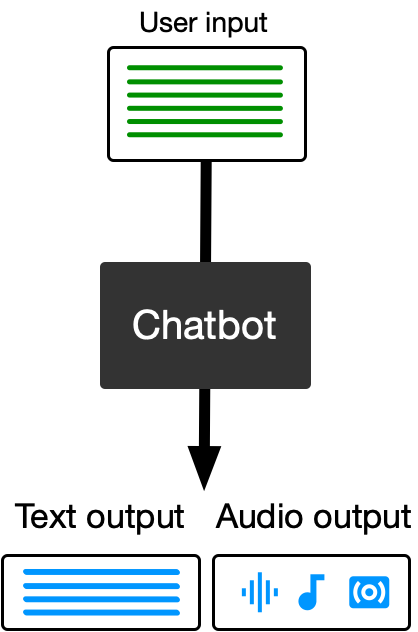
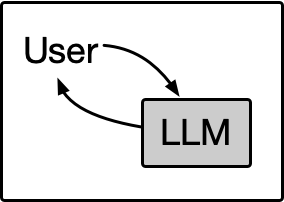
chat with user
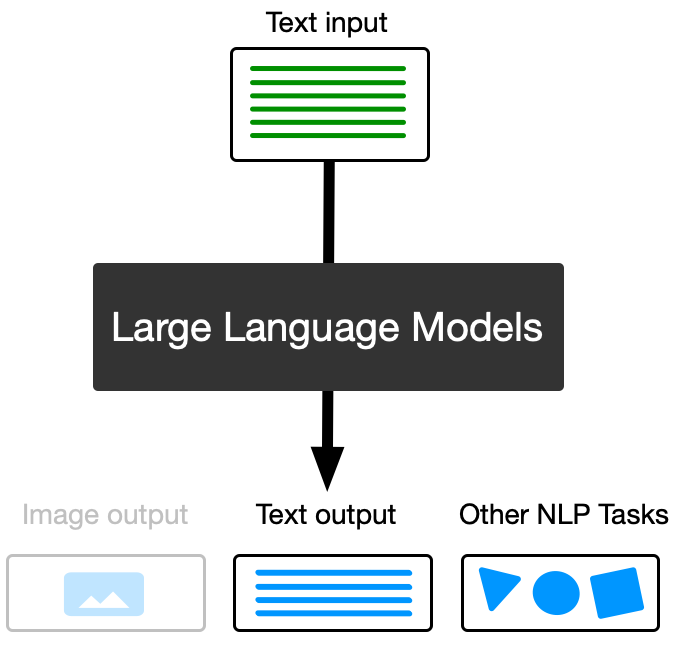
multiple purposes
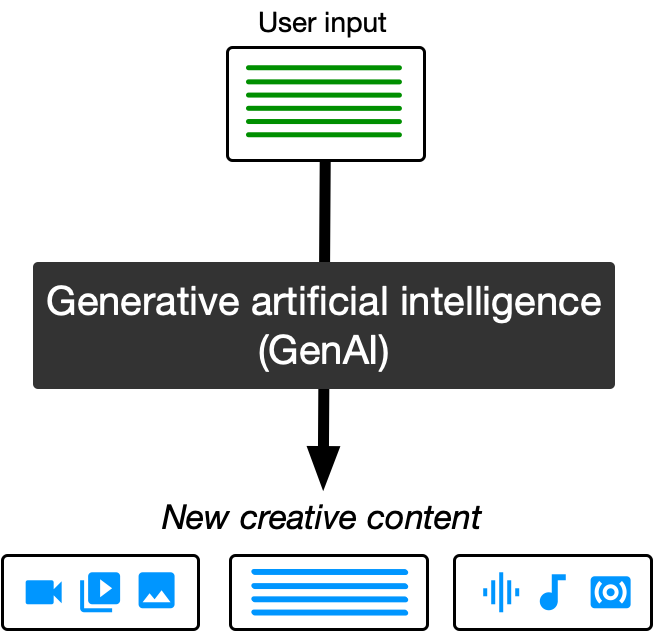
new creative content
- Note: not all LLMs power chatbots and genAI but most do.
- We’ll look at the architecture of LLM later in the workshop.
Using a LLM
Provider API
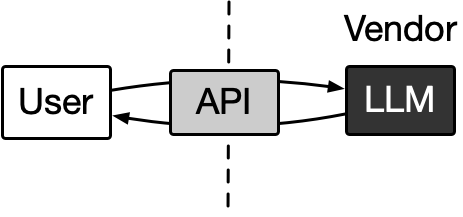









 …
- Requires internet access
- Requires account with provider
- Ongoing payment for usage
Local LLM
GPT4All LM Studio Jan llama.cpp llamafile Ollama NextChat …
- No internet access required
- No account required
- Several GB of hard disk space required
- At least 16GB RAM required for 7b parameter LLMs
![]() Ollama
 Ollama
llama3.2:1bllama3.2:3bllama3.1:8bllama3.1:70bllama3.1:405bgemma2:2bgemma2:9bgemma2:27bllava:7b- …
curl http://localhost:11434/v1/chat/completions \
-H "Content-Type: application/json" \
-d '{
"model": "llama3.2:1b",
"messages": [
{
"role": "system",
"content": "You are a helpful assistant."
},
{
"role": "user",
"content": "Hello!"
}
]
}'
- Pricing: FREE.
- The model name has a suffix with the number of parameters, e.g.
llama3.1:8bhas about 8 billion parameters. - Larger number of parameters requires larger RAM (~16GB RAM required for 7b).