Hypothesis testing
STAT1003 – Statistical Techniques
Australian National University
These slides are best viewed on a modern browser like Google Chrome on a desktop or laptop. Some interactive components may require some time to fully load.
Statistical inference
Estimation (last topic)
Draw inferences about a population by estimating population parameters from a sample (point and interval estimators).
Hypothesis testing (this topic)
Draw inferences about a population by making a claim or hypothesis about a population parameter and testing whether the hypothesis is supported by the sample.

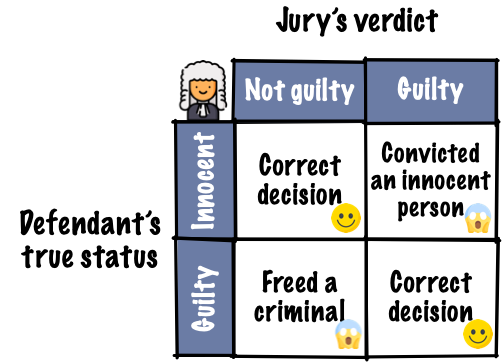
The judicial system
- In a criminal court case, the defendant is either:
- not guilty of the alleged crime or
- guilty of the alleged crime.
- The prosecutor and the defence lawyer present their evidence with assumptions to the jury and/or judge during the trial.
- The jury has to decide whether to convict the defendant or not based on the evidence.
The “statistical” judicial system
- In a “statistical” court case, there are two competing hypotheses:
- The null hypothesis (\(H_0\)) or
- The alternative hypothesis (\(H_A\) or \(H_1\)).
- A sample of data is collected and a test statistic under assumptions provides evidence to test the \(H_0\).
- Based on the strength of evidence, we decide whether to reject the \(H_0\) or not.
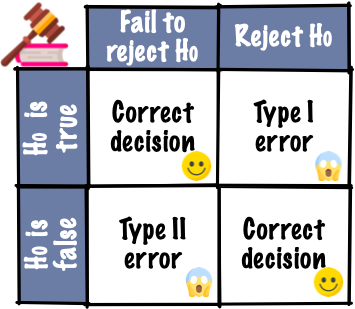
Two types of errors can occur in this process:
- Type I error: rejecting the \(H_0\) when it is actually true.
- Type II error: failing to reject the \(H_0\) when the \(H_A\) is actually true.