Advanced R Programming
STAT1003 – Statistical Techniques
Dr. Emi Tanaka
Australian National University
These slides are best viewed on a modern browser like Google Chrome on a desktop or laptop. Some interactive components may require some time to fully load.
Not examinable
Please note that this content is not examinable. It is meant to be a demonstration of how to use R for simulation studies and functional programming, which are useful skills for data analysis but not directly assessed in the course.
Functional Programming
Repetitive tasks
- 🎯 Let’s calculate the number of distinct values for each column and store it in
n
- Anything you notice from above?
Using for loops
- But R is notoriously known for being slow using for loops
- The
acrossfunction indplyrcan do this without for loops
- Note that the result is a
data.frame
Functions in R
Functions can be broken into three components:
formals(), the list of arguments,body(), the code inside the function, andenvironment()1.
Functions in R are created using
function()with binding to a name using<-or=
Function body
- The body of a function can be a single expression or a block of code enclosed in
{}.
Functional programming with purrr
purrris part of the coretidyversepackages.- It contains a series of
mapandwalkfunctions.
- The related functions in
purrrhave been design so that that input are consistent. - The user is required to think of the expected output before seeing the output.
map functions in purrr
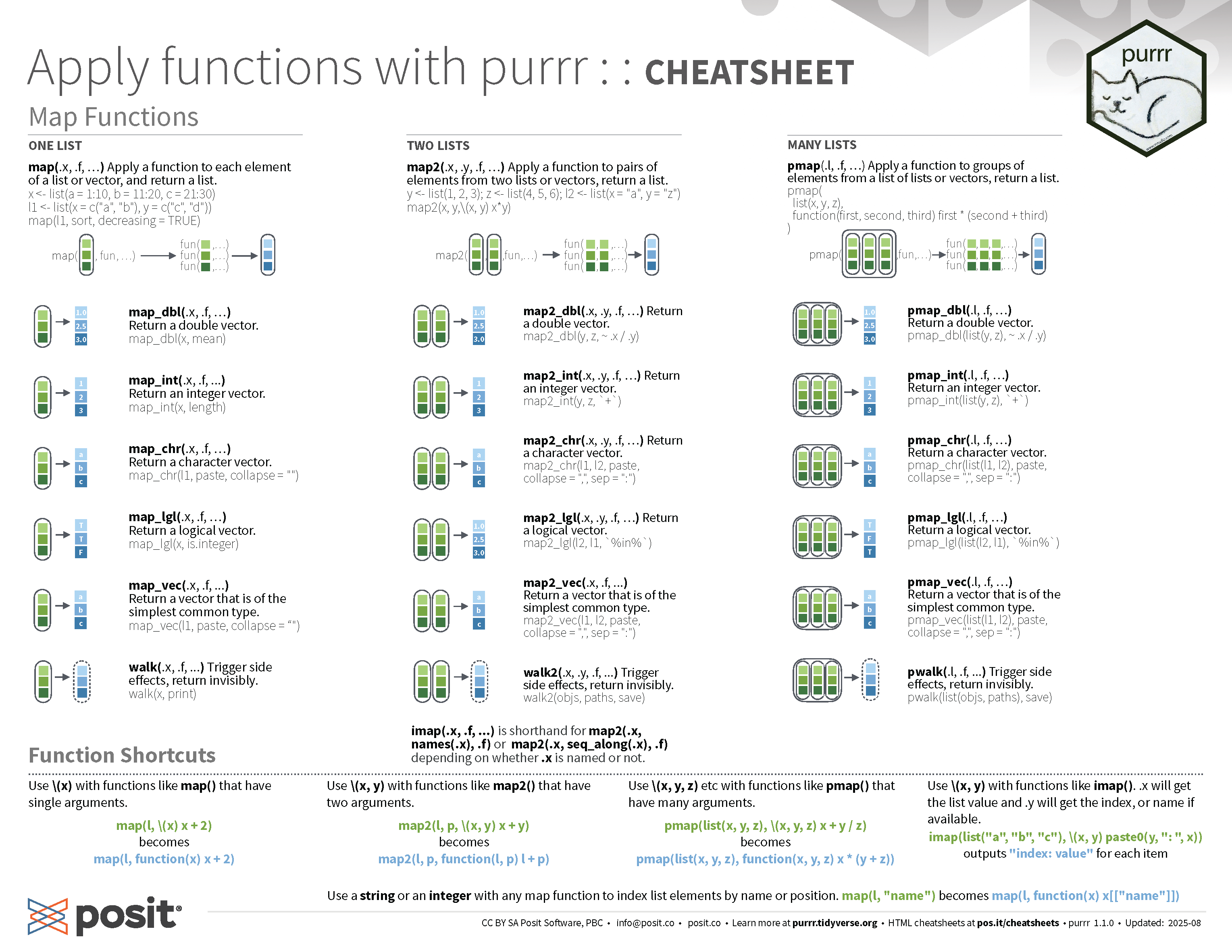
map(.x, .f, ...)returns a listmap_chr(.x, .f, ...)returns a vector of charactermap_dbl(.x, .f, ...)returns a vector of numericmap_int(.x, .f, ...)returns a vector of integermap_lgl(.x, .f, ...)returns a vector of logical
Conditional maps in purrr
map_if(.x, .p, .f, ...)uses.pto determine if.fwill be applied to.xmap_at(.x, .at, .f, ...)applies.fto.xat.at(name or position)map_depth(.x, .depth, .f, ...)apples.fto.xat a specific depth level of a nested vector- The return object is always a list
Functional programming in Base R
lapply,Map,mapply,sapply,tapply,apply, andvapplyare variants of functional programming in Base R
- Some function outputs in Base R are more predictable than others:
purrr::mapis a variant oflapply(which always returns list)purrr::pmapis a variant ofMap(which takes more than one input)
sapplydoesn’t require users to specify the output type, instead it’ll try to figure out what looks best for the user… great for interactive use but require great caution for programming
Anonymous functions
- Anonymous functions, also called lambda expression in computer programming, are functions without names.
- Since R version 4.1.0, we can use the shorthand
\(x)to define anonymous functions
- Tidyverse employs a special shorthand using a formula and
.xas a special placeholder for input
Formula anonymous function in Tidyverse
- Formula anonymous functions are not just for
purrrfunctions:
- Most
tidyversefunctions would support this formula approach to anonymous function, but likely not outside of that ecosystem unless developers adopt the same system.
Functions with two inputs
- For functions with two inputs, you can use the
map2variants inpurrr
- For anonymous functions with two inputs, the first input is
.x(as before) and the second is.y
Functions with more than two inputs
- What about if there are more than two input?
- You can use
pmapvariants inpurrr
Other functions in purrr
Using names of input
- The
imap(x)variants are shorthand formap2(x, names(x))
Expecting no return object
- If you are looking to get a side effect rather than return, you can use the
walkvariants
reduce function in purrr
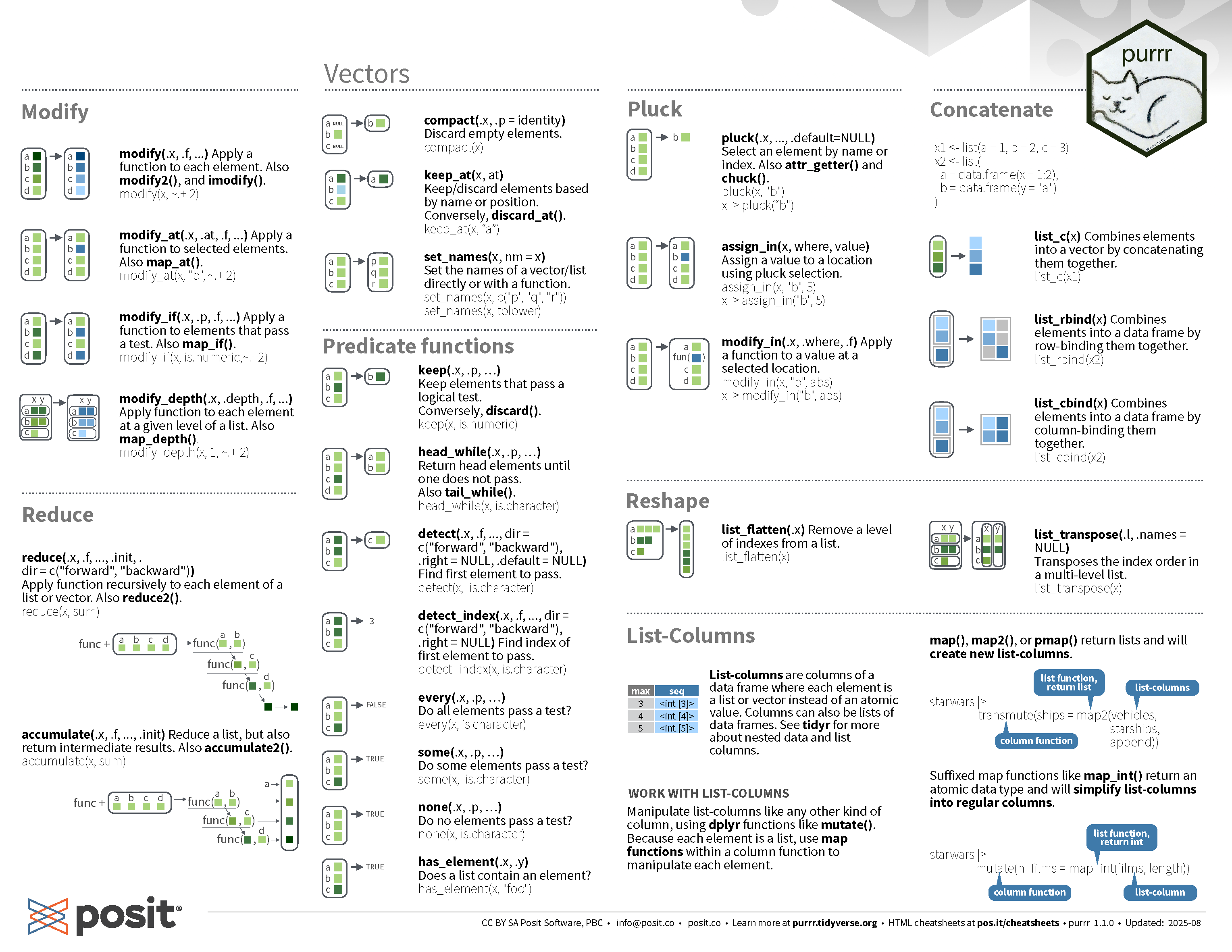
reduce(.x, .f)applies a function.fcumulatively to the elements of.x, from left to right.- E.g.
reduce(c(1, 2, 3, 4), sum)is equivalent tosum(sum(sum(1, 2), 3), 4)
accumulate(.x, .f)is similar toreduce, but it returns the intermediate results as well.
purrr cheatsheet
Simulation Design
Simulation study
- Simulation is a powerful tool to understand the behaviour of a system when we cannot easily derive the answer mathematically.
- In a simulation study, we need:
- a data generating process (DGP) that mimics the real-world process we are interested in, and
- a statistic that we want to study the behaviour of.
Simulation design
- We can consider various scenarios or factors that may affect the behaviour of the statistic.
- We can then use simulation to explore how the statistic behaves under different scenarios.
Rolling 10 dices
- Let \(X\) be the total of rolling 10 dice.
- We can get the exact distribution of \(X\) by enumerating all possible outcomes of rolling 10 dice, and counting the number of outcomes that give each possible total.
Alternative approach
This requires more memory, as it needs to store all possible outcomes of rolling 10 dice, which is \(6^{10} = 60,466,176\) outcomes. However, it is more straightforward to implement and understand.
Simulate rolling 10 dice
- We can also simulate rolling 10 dice by generating random numbers from a (discrete) uniform distribution and summing them up.
Rolling 10,000 dices
- Let \(X\) be the total of rolling 10,000 dice.
- Suppose we want to know the probability that \(X\) is greater than 35,000.
- We can use the exact distribution approach, but it is computationally infeasible as it requires enumerating all possible outcomes of rolling 10,000 dice, which is \(6^{10000}\) outcomes.
- However, we can easily simulate rolling 10,000 dice and estimate the probability that \(X\) is greater than 30,000.
Bootstrapping
- Bootstrapping is frequently used to estimate the sampling distribution of a statistic when the underlying population distribution is unknown or when the sample size is small.
- The bootstrap method involves repeatedly resampling with replacement from the observed data and calculating the statistic of interest for each resample.
Summary
- Simulation is a powerful tool to understand the behaviour of a system when we cannot easily derive the answer mathematically.
- In a simulation study, we need a data generating process (DGP) that mimics the real-world process we are interested in, and a statistic that we want to study the behaviour of.
- We can consider various scenarios or factors that may affect the behaviour of the statistic, and use simulation to explore how the statistic behaves under different scenarios.
- Simulation can be used to estimate probabilities or other characteristics of a statistic when the exact distribution is computationally infeasible to derive.
- Bootstrapping is a resampling method that can be used to estimate the sampling distribution of a statistic when the underlying population distribution is unknown or when the sample size is small.

STAT1003 – Statistical Techniques