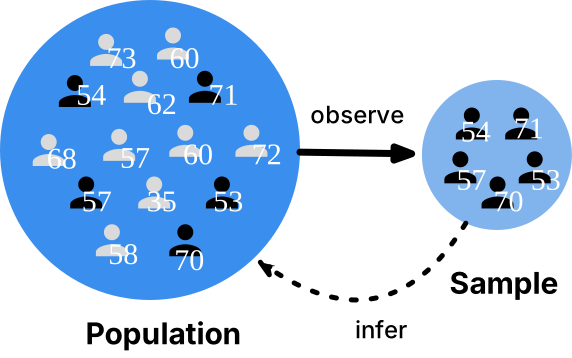
Sampling distribution
STAT1003 – Statistical Techniques
Dr. Emi Tanaka
Australian National University
These slides are best viewed on a modern browser like Google Chrome on a desktop or laptop. Some interactive components may require some time to fully load.
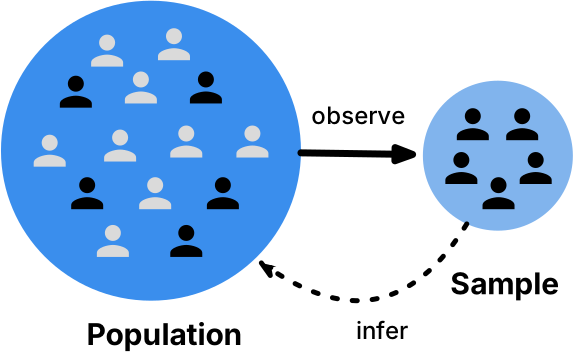
Recall: statistical inference
Statistical inference: Infer parameters of a population from a sample from that population.
![]()
- Population parameters describe populations, e.g. population mean \(\mu\) and population variance \(\sigma^2\).
- Population parameters are usually unknown.
- To find out more about them, we take a random sample of data.
- Calculate statistics from the sample, e.g. sample mean \(\bar{x}\) and sample variance \(s^2\).
- Use \(\bar{x}\) and \(s^2\) to estimate \(\mu\) and \(\sigma^2\).
Sampling distribution
- Sample statistics, like the sample mean (\(\bar{X}\)) and sample variance (\(S^2\)), are random variables.
Sampling distribution refers to the distribution of a statistic that would arise if we repeatedly took random samples from a population.
Sampling distribution of a sample mean
Expected value of a sample mean
- Suppose \(X_1, X_2, \ldots, X_n\) are independent random variables drawn from a population with mean \(\mu\) and finite variance \(\sigma^2\) (we refer to this as independent and identically distributed or i.i.d.).
- Then the sample mean \(\bar{X}\) is given by:
\[
\bar{X} = \frac{1}{n}(X_1 + X_2 + \ldots + X_n)
\]
- The expected value of the sample mean \(\bar{X}\) is equal to the population mean \(\mu\):
\[
\begin{align*}
\text{E}(\bar{X}) &= \text{E}\left(\frac{1}{n}(X_1 + X_2 + \ldots + X_n)\right) \\
&= \frac{1}{n}(\text{E}(X_1) + \text{E}(X_2) + \ldots + \text{E}(X_n)) \\
&= \frac{1}{n}(n\mu) = \mu
\end{align*}
\]
Standard error
The standard error (SE) of a statistic is the standard deviation of its sampling distribution.
For the sample mean \(\bar{X}\):
\[
\begin{align*}
\left[\text{SE}(\bar{X})\right]^2 &= \text{Var}\left(\frac{1}{n}(X_1 + X_2 + \ldots + X_n)\right) \\
&= \frac{1}{n^2}\text{Var}(X_1 + X_2 + \ldots + X_n) \\
&= \frac{\sigma^2}{n}
\end{align*}
\]
But since \(\sigma\) is usually unknown, we use the sample standard deviation \(s\) to estimate it. Thus, we have \(\widehat{\text{SE}}(\bar{X}) = \dfrac{s}{\sqrt{n}}\).
Exact sampling distribution 1
- When dealing with experiments that are random and well-defined in a purely theoretical setting, we are able to find the exact sampling distribution.
- Suppose we roll a fair four-sided die and let \(X\) be the number that comes up.
- The population can be thought of as an infinite number of rolls of the die.
- If we repeatedly draw samples of size 2, i.e., roll the die twice, find the sampling distribution of the sample mean \(\bar{X}\).
- The population distribution of \(X\) is:
| \(P(X = x)\) |
\(\frac{1}{4}\) |
\(\frac{1}{4}\) |
\(\frac{1}{4}\) |
\(\frac{1}{4}\) |
- \(E(X) = 2.5\) and \(\text{Var}(X) = 1.25\).
Exact sampling distribution 2
- How about the sampling distribution for sample mean \(\bar{X}\) when the sample size \(n = 2\)?
- The possible values of \(\bar{X}\) are:
| 1 |
2 |
3 |
4 |
| 1 |
1.0 |
1.5 |
2.0 |
2.5 |
| 2 |
1.5 |
2.0 |
2.5 |
3.0 |
| 3 |
2.0 |
2.5 |
3.0 |
3.5 |
| 4 |
2.5 |
3.0 |
3.5 |
4.0 |
- The (exact) sampling distribution of \(\bar{X}\) is:
| \(P(\bar{X} = \bar{x})\) |
\(\frac{1}{16}\) |
\(\frac{2}{16}\) |
\(\frac{3}{16}\) |
\(\frac{4}{16}\) |
\(\frac{3}{16}\) |
\(\frac{2}{16}\) |
\(\frac{1}{16}\) |
- \(E(\bar{X}) = 2.5\) and \(\text{Var}(\bar{X}) = 0.625\).