Communicating with Data

STAT1003 – Statistical Techniques

Dr. Emi Tanaka

Australian National University

These slides are best viewed on a modern browser like Google Chrome on a desktop or laptop. Some interactive components may require some time to fully load.

Communicating

To effectively communicate, we must realize that we are all different in the way we perceive the world and use this understanding as a guide to our communication with others.

– Anthony Robbins


Communicating with data

The two words ‘information’ and ‘communication’ are often used interchangeably, but they signify quite different things. Information is giving out; communication is getting through.

– Sydney J. Harris


Effective communication

  • There is no single, ideal way to communicate
  • Competence is situational and relational (where, what and who)
  • Communication doesn’t always require complete understanding
  • We notice some messages more and ignore others, e.g. we tend to notice messages that are:
    • intense,
    • repetitious, and
    • constrastive.
  • We are influenced by what is most obvious

Telling stories with data

No one ever made a decision because of a number. They need a story.

– Daniel Kahneman


  • Storytelling is a powerful technique to communicate data
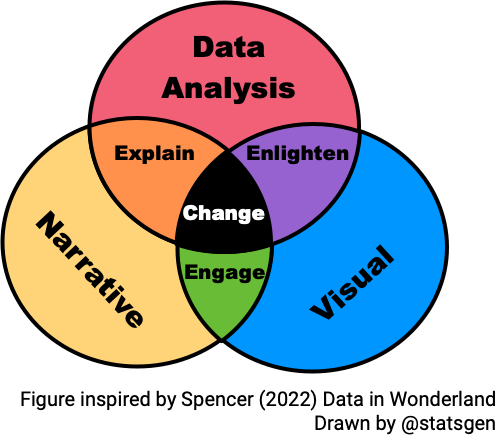
Principles of communicating data

  1. Know your goal (target audience, intended message, desired effect)
  2. Use the right data
  3. Select suitable visualisations
  4. Design for aesthetics
  5. Choose an effective medium and channel
  6. Check the results, i.e. get feedback

Elements of statistical persuasion

  • Magnitude of effects: the strength of a statistical argument is enhanced in accord with the quantitative magnitude of support for its qualitative claim.
  • Articulation of results: the degree of comprehensible detail in which conclusions are phrased.
  • Generality of effects: the replicability of the results.
  • Interestingness of argument: the potential to change people believe.
  • Credibility of argument: the believability of a claim.

Data journalism

Five rules for evidence communication

  1. Inform, not persuade
  2. Offer balance, not false balance
  3. Disclose uncertainties
  4. State evidence quality
  5. Inoculate against misinformation

Code of Practice for Statistics

The Code of Practice for Statistics ensures that statistics are not just numbers, but reliable tools for understanding the world, providing insight to inform understanding and shape action.


The Code Principles

Trustworthiness

  1. Show integrity
  2. Lead responsibly
  3. Be transparent
  4. Manage data responsibly

Quality

  1. Prioritise quality
  2. Be rigorous
  3. Be open about quality

Value

  1. Be relevant
  2. Be clear
  3. Be accessible