Summary statistics for bivariate data

STAT1003 – Statistical Techniques

Dr. Emi Tanaka

Australian National University

These slides are best viewed on a modern browser like Google Chrome on a desktop or laptop. Some interactive components may require some time to fully load.

Bivariate data

Bivariate data involves two different variables (\(x\) and \(y\)) for each observation.

  • Suppose \(x_i\) and \(y_i\) are two variables measured on the same unit \(i\) for \(i = 1, 2, \ldots, n\).
  • It allows us to explore relationships and associations between the two variables.
  • Examples:
    • Height and weight of individuals.
    • Temperature and ice cream sales.
    • Study time and exam scores.
    • Eye color and hair color.
Categorical Numerical
Categorical
  • Contingency table
  • Stacked barplot
  • Percent stacked barplot
  • Side-by-side barplot
  • Group summary statistics
Numerical
  • Group summary statistics
  • Scatterplot
  • Covariance
  • Correlation coefficient

Contingency table

A contingency table (also known as a cross-tabulation or crosstab) display the frequency distribution of two or more categorical variables.

What do you notice between these two approaches?

Stacked barplot

A stacked barplot is used to compare the composition of different groups in a dataset, especially contribution of sub-categories to the total within each main category.

Percent stacked barplot

A percent stacked barplot is ideal for comparing the relative frequencies of subgroups within categories, rather than their absolute counts.

Side-by-side barplot

A side-by-side barplot (also called a grouped barplot) is used to visually compare the values of different subgroups across categories.

Group summary statistics

For a bivariate data where one variable is numerical and the other is categorical, you can use summary statistics for univariate data for each group.

  • For example, numerical statistics for each group can be computed as:

Graphical statistics by group

  • Likewise, we can compute graphical statistics for each group.

Beeswarm plot is a type of scatterplot that shows the distribution of data points while avoiding overlap, making it easier to visualize the density and spread of the data.

Case study 🌾 Wheat seed morphological characteristics

A dataset was collected to investigate morphological characteristics associated with seed weight in a line of diploid wheat (Triticum monococcum).

  • DSeed - identifier for each seed
  • Weight - weight of seed (mg)
  • Length - length of seed (mm)
  • Diameter - diameter of seed (mm)
  • Moisture - mositure content of seed (as a percentage)
  • Hardness - endosperm hardness

Scatterplot

A scatterplot is a graphical representation that displays the relationship between two numerical variables by plotting individual data points on a two-dimensional graph.

Sample covariance

Sample covariance is a measure of how much two numerical variables change together.

\[ s_{xy}=\frac{1}{n-1} \sum_{i=1}^{n}\left(x_{i}-\bar{x}\right)\left(y_{i}-\bar{y}\right) \]

  • Interpretation:
    • When \(s_{xy} > 0\), the variables tend to increase together.
    • When \(s_{xy} < 0\), one variable tends to increase when the other decreases.
    • When \(s_{xy} = 0\), there is no linear relationship between the variables.

Consider the following dataset with two variables, \(x\) and \(y\):

\(i\) \(x\) \(y\)
1 1 10
2 2 70
3 3 100

\[s_{xy} = \frac{1}{2}\left[(1-2)(10-60)+(2-2)(70-60)+(3-2)(100-60)\right]=45\]

  • But the magnitude of covariance is not easy to interpret since it depends on the units of the variables.

Pearson’s correlation coefficient

  • Correlation coefficient is a normalised version of covariance.
  • The sample Pearson correlation coefficient, denoted as \(r\), is a measure of the strength of a linear relationship between two variables (\(x\) and \(y\)).

\[r = \frac{\sum_{i=1}^n(x_i-\bar{x})(y_i - \bar{y})}{\sqrt{\sum_{i=1}^n(x_i - \bar{x})^2\sum_{i=1}^n(y_i - \bar{y})^2}}\]

  • The correlation coefficient ranges from -1 to 1.

Interpretation of correlation coefficient
  • The sign of the correlation coefficient indicates the direction of the relationship.
  • The magnitude indicates the strength of the linear relationship.
\(|r|\) Interpretation
0.8 - 1.0 Very strong association
0.6 - 0.8 Strong association
0.4 - 0.6 Moderate association
0.2 - 0.4 Weak association
0.0 - 0.2 Very weak association

Wrong interpretation of correlation coefficient


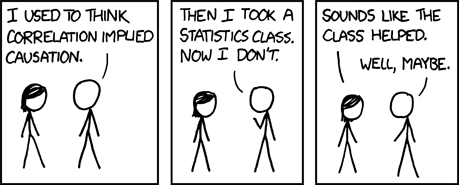
Source: xkcd

Just because \(x\) and \(y\) are highly correlated, it does not mean that \(x\) causes \(y\) or vice versa – correlation is not causation!

  • Number of ice cream sales and the rate of drowning deaths.
  • It is also easy to get spurious correlation if computing many pairwise correlations.
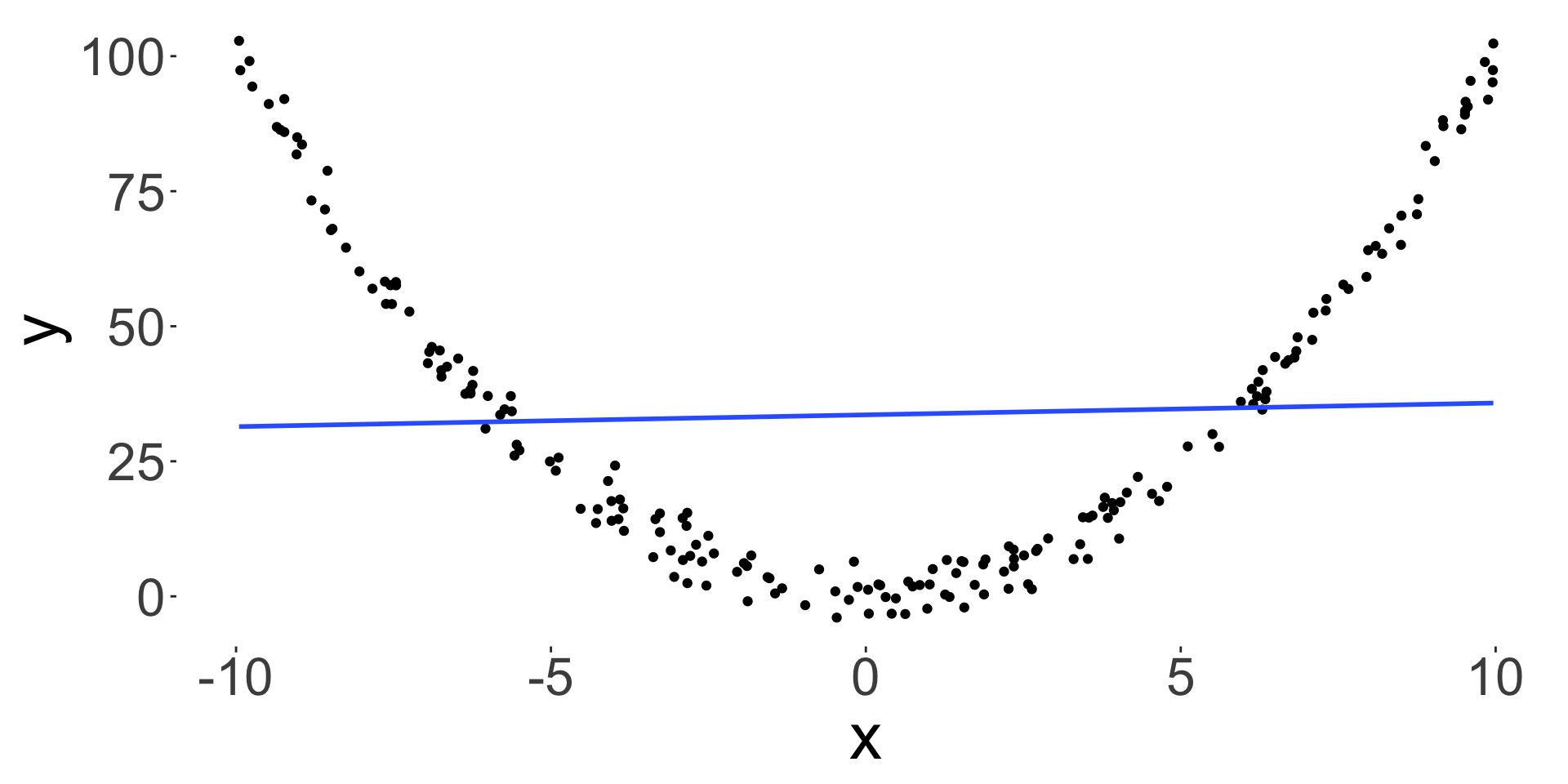
  • Correlation also only measures a linear relationship, so low correlation doesn’t mean that there is no relationship.

\[r = 0.0414779\]

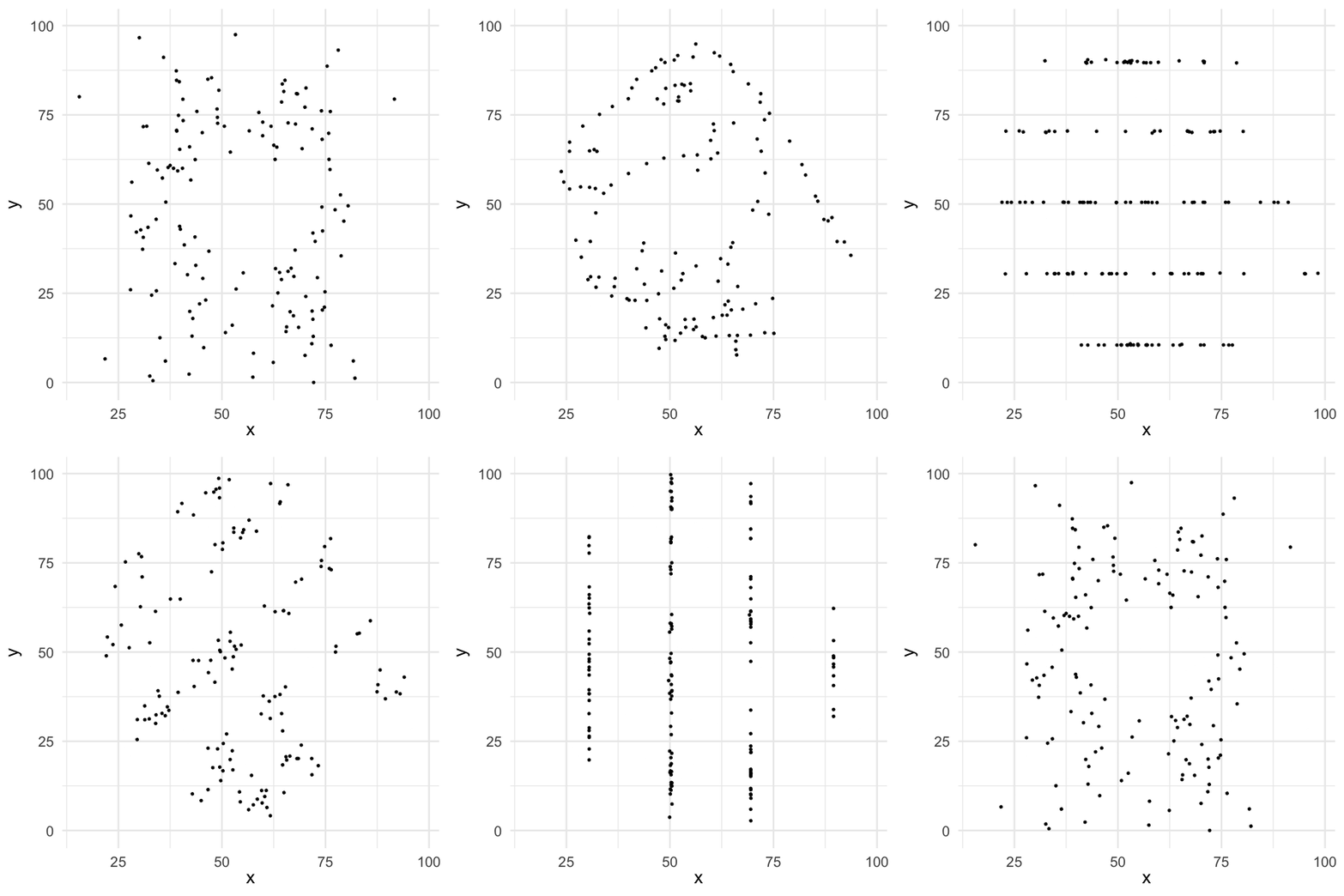
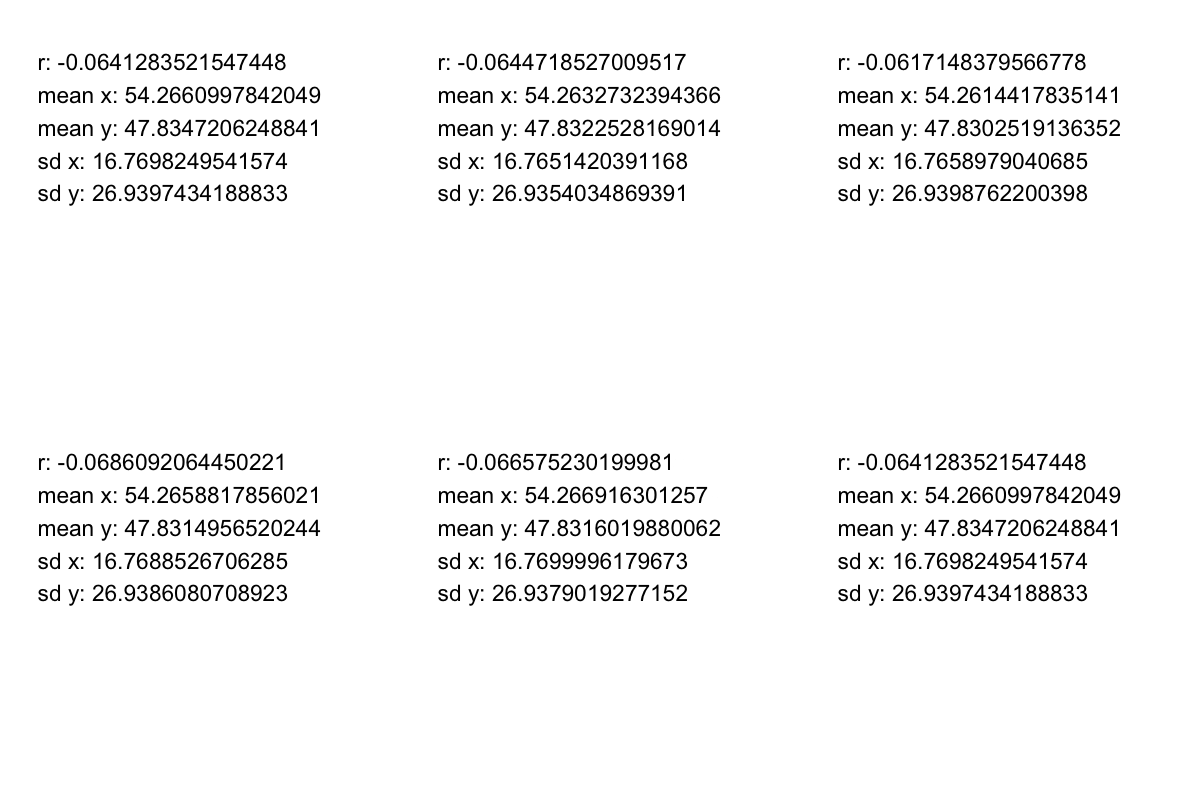
Summary statistics can be misleading

  • You can have a bivariate dataset with the exact same:
    • marginal mean,
    • marginal variance and
    • correlation, but the relationship between the two variables can be very different.
  • Always plot your data!

Summary

Categorical Numerical
Categorical
  • Contingency table
  • Stacked barplot
  • Percent stacked barplot
  • Side-by-side barplot
  • Group summary statistics
Numerical
  • Group summary statistics
  • Scatterplot
  • Covariance
  • Correlation coefficient
  • Correlation \(\neq\) Causation
  • Always plot the data!